
Most advice about the corporate Christmas party starts in the wrong place. It starts with venue, menu, theme, drinks package, or whether the DJ comes on after dessert. Those details matter. But they’re not the first question, and I think most organisers are answering a question nobody asked.
Here’s the one that actually matters: what does this event tell your team, and everyone your team talks to, about who you are as a company?
The average workplace spends $9,722 on its Christmas party, and some large corporations spend well over $100,000. That is not small-talk money. That’s a statement budget. And yet most organisations still plan the night like it’s a logistics problem to be solved, rather than a chance to say something true and proud about the place they’ve built.
Is “good enough” really the bar here? A Christmas party is one of the only nights a year when your whole team is in one room, off the clock, watching how you show up. What you do with that night either confirms the story your people already tell about your culture, or quietly undercuts it. For organisers weighing format against outcomethis guide to choosing a Christmas party venue that bonds your team is a useful place to start, because venue only earns its cost when it’s actually serving the culture you’re trying to reinforce.
Your Christmas Party Is Already Sending a Message
Here’s the thing nobody tells you when you take on the job of planning this event: it doesn’t sit outside your culture. It is your culture, on display, for one night, in front of an audience that includes your team, their partners, the new starter who’s only been there six weeks, and, increasingly, whoever ends up seeing the photos.
People notice who gets thanked. They notice whether the night feels like a genuine reward or a box being ticked. They notice whether it feels like their company’s party, or like any party, at any company, that happened to book the same function room.
And then they talk about it. To their partner on the drive home. To their mates at the next barbecue. To the candidate they’re trying to convince to come work with them. Your Christmas party has a life well beyond the night itself. It becomes part of how your people describe you to the outside world.
Ask yourself honestly: if your event doesn’t give your team something they’re genuinely proud to talk about, has that five-figure budget bought anything more than catering?
What a Great Christmas Party Should Say About You
A Christmas party worth being proud of makes a handful of things unmistakably true, not just visible on the night, but true enough to repeat later.
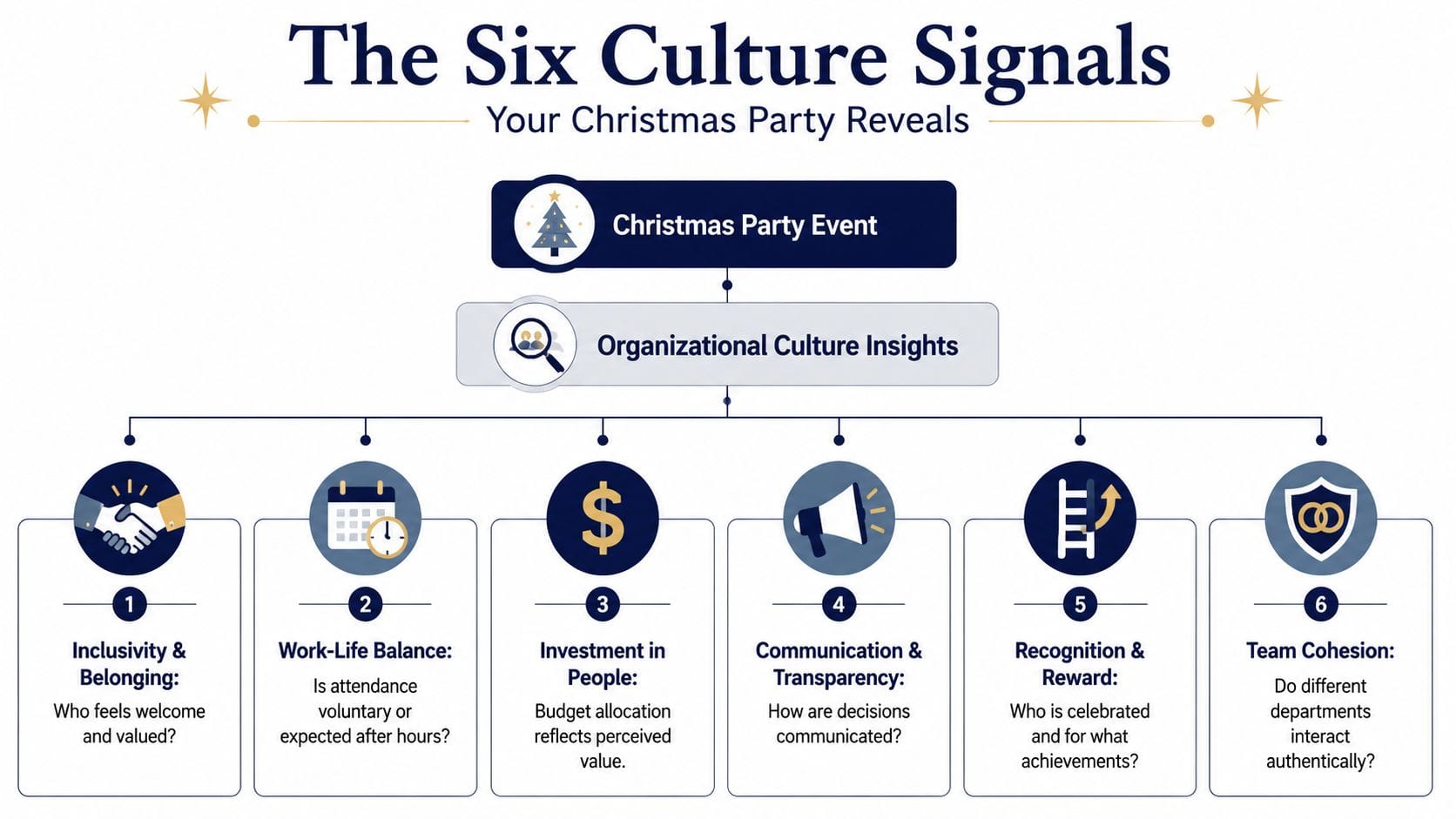
It says people are seen, specifically. Generic thank-yous land as admin. Specific, values-based recognition, naming the effort, the resilience, the quiet consistency, lands as something your team will actually repeat to each other later. That’s the difference between “nice night” and “I work somewhere that notices.”
It says everyone belongs here, not just the loudest people in the room. A strong Christmas party gives people more than one way to take part, accessible venues, mixed formats, low-pressure entry points, and ways to engage that don’t centre on alcohol. That’s not a compliance checkbox. It’s a genuine statement about who gets to feel like they belong.
It says your teams actually like each other. Left alone, people default to their existing group, same department, same desk cluster, same three names they always sit with. A shared activity or collaborative moment gives people a reason to cross that line, and gives you a room that genuinely feels connected rather than just co-located.
It says your leaders are part of the team, not above it. When leaders join in, not just deliver a speech and duck out early, it tells your people something leadership decks never will: that the people running the place are willing to have the same experience as everyone else.
It says your team is allowed to enjoy themselves. Some workplaces are so conditioned to stay polished that nobody quite relaxes, even at the end-of-year party. The best cultures give people explicit permission to laugh, be a bit silly, and enjoy each other’s company without anyone feeling unprofessional for joining in.
It says you stand for something beyond the room. A night that connects to genuine community impact, not just the bar tab, tells your team their company’s values extend past the P&L.
Building the Statement on Purpose, Not by Accident
What’s the strongest planning shift you could make here? Stop starting with entertainment options, styling boards, or the first venue with a date free. Start with the statement you want your people to walk away and repeat.
That single shift changes your whole planning sequence, and it gives you a much better filter for trade-offs. Want your team to walk away saying “we actually like working together”? A beautiful but static cocktail room probably isn’t earning its budget. Want them saying “this company actually stands for something”? A standard sit-down dinner is too thin to carry that message on its own.
For organisers trying to connect these choices to a bigger people strategy, team building that aligns with your business objectives is a genuinely useful way to frame the decision.
Start with the signal, not the schedule
Before you talk to a single supplier, define the statement you want the night to make. Recognition. Belonging. Genuine connection. Leadership that shows up as people, not titles. A sense of shared purpose. Then build backwards, format, facilitation, timing, flow, from there.
This is where Christmas team building earns its place as more than an add-on. It’s how you create the moments that back up your statement, rather than hoping the right story tells itself. Charity formats are a particularly strong option for teams who want the night to say something about purpose: our charity team building programs have raised over $3.1 million for worthy causes, proof that a night out can carry genuine connection and measurable community impact in the same breath (Corporate Challenge Events Power of Play).
Christmas Party Culture Planning Tool
| If you want your team to say… | Design for… | Avoid… | Best-fit Christmas party format |
|---|---|---|---|
| “We’re genuinely appreciated” | Specific appreciation, values-based shoutouts, team storytelling, recognition of behind-the-scenes effort | Generic speeches only, broad thank-yous that blur everyone together | Facilitated recognition moments, team awards, charity team building with reflection |
| “This team actually likes each other” | Shared tasks, mixed groups, collaborative challenges across departments | Static formats where people stay in familiar cliques | Amazing Race-style activities, problem-solving challenges, game-show entertainment |
| “Everyone belongs here” | Choice, varied roles, low-pressure participation, accessible venue design, options beyond alcohol-centred socialising | One-format nights that only suit loud, highly social participation | Charity team building, creative challenges, facilitated team activities |
| “This place has real energy” | Movement, laughter, surprise, light competition, a tight run sheet | Long speeches, long waits, over-formal sequencing | Mini Olympics, game shows, outdoor challenges, Christmas energisers |
| “We stand for something” | Contribution beyond the room, visible alignment with values, shared effort | Celebrations that feel disconnected from community or company values | Charity team building, Bikes for Tykes, Toys for Tykes, Give a Dog a Home, Play It Forward |
| “Our leaders are one of us” | Leaders joining in, mixed-team participation, shared challenge, visible humility | Leadership-only speeches, executive tables, leaders leaving early | Facilitated play-based activity with leaders participating alongside the team |
A table like this helps EAs, office managers, and People & Culture leaders make cleaner decisions under pressure, and it helps when different stakeholders want different things. Instead of arguing over whether a DJ, trivia host, or banquet package sounds more exciting, the conversation can return to the question that actually matters: what do we want our people saying about us on Monday morning?
A better brief for any supplier isn’t “make it fun.” It’s “help our team walk away proud to say this is who we are.”
Why Play Is the Vehicle
Play isn’t a novelty layer bolted onto a “proper” corporate event. It’s the mechanism that actually produces the outcomes leaders say they want from the night.
Take trust. It doesn’t build itself just because people are standing in the same room holding the same drink. Stanford research found that people who simply believed they were working collaboratively persisted 48 to 64% longer on a hard task and reported less fatigue, even when the “collaboration” was only symbolically cued (Carr, Walton & Cohen, 2015). That’s the effect of a belief. A genuine shared challenge, where people are actually solving something side by side, asks the obvious question: what could it do for a room full of colleagues who already know each other?
Leadership behaves differently inside a shared task, too. A stage says “I’m in charge here.” Standing shoulder to shoulder in the same challenge says “I’m one of you,” a message no speech quite manages to send on its own.
And for the people who’d never take a mic, a shared task is often the fastest way into the room. Contribution stops meaning “perform” and starts meaning “show up and try.”
None of that is “we had a nice dinner.” It’s the difference between a night people attended and a moment they were part of.
The Science of How Playful Connection Sticks
There’s a practical reason shared playful experiences tend to stay with people. They engage more of the person than passive observation does. People are moving, reacting, paying attention to one another, and participating rather than just consuming.
Play works with human biology
When people play together, brain chemistry does a lot of the connecting for them. Oxytocin, the bonding hormone, is released. Mirror neurons fire in sync, so people feel attuned to one another almost without trying. And the nervous system shifts out of fight-or-flight and into something calmer and more open (National Institute for Play). Attunement plus a lowered guard is the actual physiological foundation of trust. It isn’t just a nice mood. It’s chemistry doing its job.
For readers wanting a deeper workplace lens on the brain side of play, why your teams needs a dose of play adds useful context. The key point for a positive team culture is straightforward: memorable connection is more likely when people are emotionally engaged and actively involved, not sitting on the sidelines.
Questions worth asking before anything gets booked
Use this checklist before you lock in format or supplier:
- The statement: What do we want our team saying about us after this event?
- Recognition gaps: Who usually gets recognised, and who could easily be missed?
- Genuine connection: Will people actually mix, or does the format need to create a reason to?
- Entry points: Will quieter staff have a comfortable way in?
- Range of participation: Does the format work across different personalities, roles, and comfort levels?
- Leadership behaviour: Are leaders joining the experience, or only presenting at it?
- A shared moment: Is there an actual shared activity, or only a shared location?
- The Monday-morning test: What will people still be talking about after the event, and is that the story you wanted told?
- Permission to enjoy it: Does the format let people relax and actually enjoy the team around them?
If the only answer to “what will people remember?” is the venue, the event probably needs another layer.
Give Your Team Something to Be Proud Of
A Christmas party will say something about your company either way. The only question is whether you decide what that something is, or leave it to chance.
Could this be one of the most under-used strategic moments on your entire calendar? It’s not just an event theme, it’s a chance to hand your people a genuine, repeatable reason to be proud of where they work. Not a slogan on a wall. A night they actually lived, that backed up everything you say you stand for.
For People & Culture leaders, EAs, office managers, and team leads, the smartest planning question isn’t “what should happen on the night.” It’s “what do we want our people telling everyone else, afterwards, about who we are.” A team that feels genuinely appreciated tells that story differently to a team that got a seat and a drink. A company that shows up as itself, leaders included, tells that story differently to one that just booked a room.
Your Christmas party isn’t just the end of the year. Done well, it’s proof, the kind your team carries with them, and repeats, long after the lights come up.
Corporate Challenge Events helps teams create Christmas parties and end-of-year events that reveal and strengthen positive team culture through play based team building, charity team building and serious fun with lasting impact.




Recent Comments