
“Can you just organise something simple for Christmas?”
As an EA, People and Culture leader or workplace organiser, you know “simple” rarely describes the work involved. Before anyone else gives it another thought, you are calculating the budget, venue, team expectations, accessibility, approvals and suppliers.
The challenge is not that any single decision is particularly difficult. It is that dozens of interconnected decisions are now sitting with you, alongside the work you were already responsible for.
That is the hidden load of Christmas party planning. Everyone else sees one occasion on the calendar. The organiser sees a web of decisions about people, money, logistics, inclusion, risk and the experience the organisation wants to create.
This article maps that workload into 47 decisions, then uses five moves to place each one where it belongs: retain, combine, delegate, transfer or eliminate. The standard stays high without leaving one capable person to hold the entire event together.
The 47 Decisions Hiding Inside a Simple Christmas Party
Why 47? Because once we started unpacking what sits behind “something simple”, that is where the list landed. Your event may involve 39 decisions or 63, but 47 makes the point: a Christmas party is never just one item on a to-do list.
Planning and logistics
- Date
- Backup date
- Lunch, afternoon or evening format
- Start and finish times
- Venue type
- Venue location
- Transport
- Parking
- Room layout
- AV requirements
- Accessibility
- Wet-weather contingency
People
- Guest list
- Whether partners are invited
- Whether families or children are included
- Dietary requirements
- Mobility, sensory or individual requirements
- RSVP deadline
- RSVP follow-up
- Seating or group-mixing approach
Money
- Total budget
- Per-person budget
- Approval authority
- Deposit and payment timing
- Must-haves versus optional extras
- Contingency allowance
- Whether employees carry any personal costs
Experience
- What the team should feel or remember
- Activity or entertainment
- Theme and styling
- Facilitator or MC
- Music
- Recognition moments
- Speeches and presenters
- Photography or content capture
- Gifts, prizes or awards
- Food and service style
Culture and risk
- Alcohol policy
- Non-alcoholic options
- Cultural and religious inclusion
- Inclusion of new, quiet or remote employees
- Behaviour and overconsumption management
Coordination and administration
- Number of suppliers
- Contracts and cancellation terms
- Invitations and calendar holds
- On-the-day responsibilities
- Post-event communication
The value of the list is not giving the organiser 47 boxes to tick. It is making the hidden workload visible so decisions can be placed with the right people instead of quietly defaulting to one person.
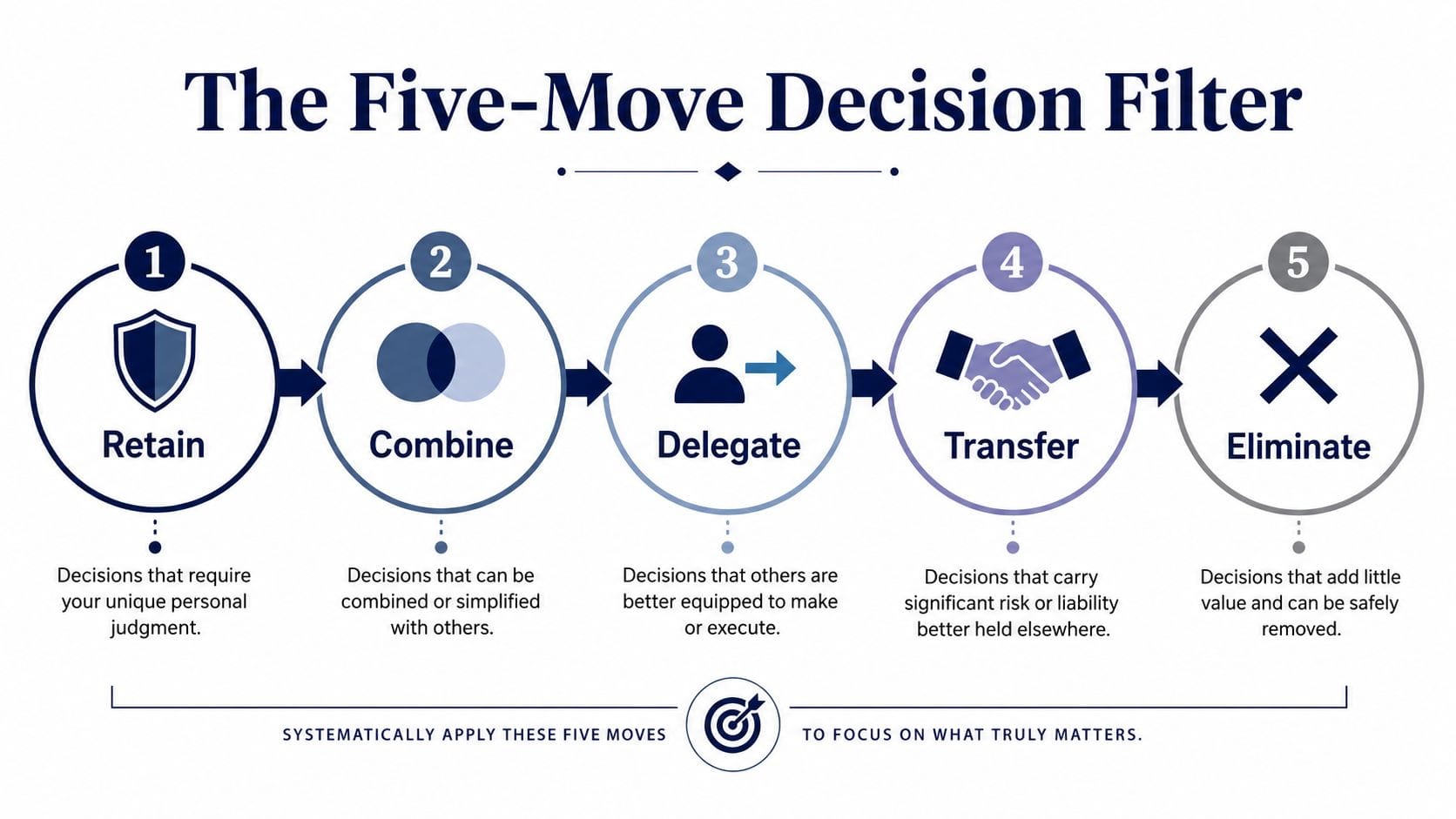
The Five-Move Decision Filter
A standard corporate Christmas party checklist tells you what needs to happen. It rarely tells you who should decide it, which choices belong together or when a supplier should own the outcome. The five-move filter does:
| Move | What it does | The question to ask |
| Retain | Protects the decisions that need your context or authority | Does this require judgement only I can provide? |
| Combine | Groups interconnected choices into one coherent decision | Which other decisions will this affect? |
| Delegate | Gives a defined internal decision to a named owner | Can someone else resolve this within clear boundaries? |
| Transfer | Places delivery responsibility with an accountable supplier | Can a supplier own the outcome, not merely complete a task? |
| Eliminate | Stops low-value decisions consuming time | Will this choice materially improve the event? |
The route depends on the organisation and event model. The goal is not to outsource everything, but to stop treating every decision as though it requires the organiser’s attention.
Move One: Retain the Decisions That Require Your Judgement
Retain the decisions that depend on organisational knowledge, authority or strategic judgement. These commonly include:
- What the event needs to achieve
- What the team should feel or remember
- Budget boundaries and approval points
- Recognition priorities
- Inclusion requirements
- Organisational risk settings
- Final approval
The most useful test is:
| Does this decision require context, authority or judgement that only I possess? |
If the answer is yes, retain it. Deciding whether the event should recognise the year’s contribution, reconnect departments or create a shared charity outcome sets the direction for everything that follows.
Retaining that decision does not mean completing all the attached work. You can decide that connection is the priority without selecting every activity or coordinating the equipment. Define the outcome and boundaries clearly enough for others to act.
Move Two: Combine Decisions That Belong Together
Christmas party decisions have a habit of reopening one another. Change the activity and the room layout, timing, transport and budget may all need another look. Combining related decisions reduces that rework:
- Experience: Desired outcome, format, activity, entertainment, facilitator, theme and recognition.
- Hospitality: Venue, catering, drinks, timing, room layout and transport.
- Governance: Budget, approvals, contracts, contingency and cancellation terms.
- Participation: Guest list, accessibility, dietary requirements, invitations and RSVPs.
Consider each cluster as one conversation. Venue selection, for example, should support the experience rather than happen in isolation because a room is available. This guide to choosing a Christmas party venue that helps the team connect explores that relationship.
Clusters also reveal trade-offs. A suitable venue may remove the need for extra entertainment, while a facilitated programme may provide the structure and team mixing that would otherwise require several separate choices.
Move Three: Delegate Decisions With Clear Boundaries
“Can you help with the Christmas party?” is not delegation if the organiser remains responsible for every outcome. Useful delegation gives one named person authority to close a defined decision. Include:
- Owner: The person accountable for resolving it
- Decision: The exact choice or outcome they control
- Boundary: The budget, policy or quality limit they must follow
- Deadline: When the decision needs to be closed
- Escalation: What would require further approval
RSVPs, dietary information, invitations, internal communications and photography can often follow this route. Give the owner enough authority to act without returning for approval at every step. Clear delegation removes a decision from the organiser’s workload. Vague delegation adds another person to follow up.
Move Four: Transfer Delivery Decisions to an Accountable Supplier
Transferring a decision is different from outsourcing a task.
If a supplier is asked to deliver equipment at 2 pm, the organiser still owns the design, timing, setup, venue coordination and flow. One task has moved, but the decisions remain internal.
When responsibility is transferred properly, the supplier owns the agreed outcome within a clear brief. An event partner may manage programme design, facilitation, equipment, timing and contingencies. The organiser retains the purpose, standards, budget and approval points without managing every operational choice.
This matters when disconnected suppliers would create more handovers. Each provider can introduce another brief, contract, arrival time and contact for the organiser to monitor.
The aim is to place delivery decisions with the people best equipped to make them. If time is already the biggest constraint, this guide to pulling off a last-minute Christmas party shows how a format with fewer moving parts can help.
Move Five: Eliminate Decisions That Do Not Improve the Outcome
Not every detail deserves a decision-making process. Styling and creative touches matter when they support the experience. Low-impact options should not absorb more time than decisions affecting participation or quality.
Use this test:
| Will this choice materially affect safety, inclusion, cost, participation or the experience we want people to have? |
If the answer is no, select a sensible default and move on. Use the venue’s standard linen. Choose one suitable invitation design. Stop debating whether the table decorations should be red, green or “more sophisticated red.”
Elimination protects time for choices guests will notice and outcomes the organisation genuinely values.
The Five-Move Decision Filter
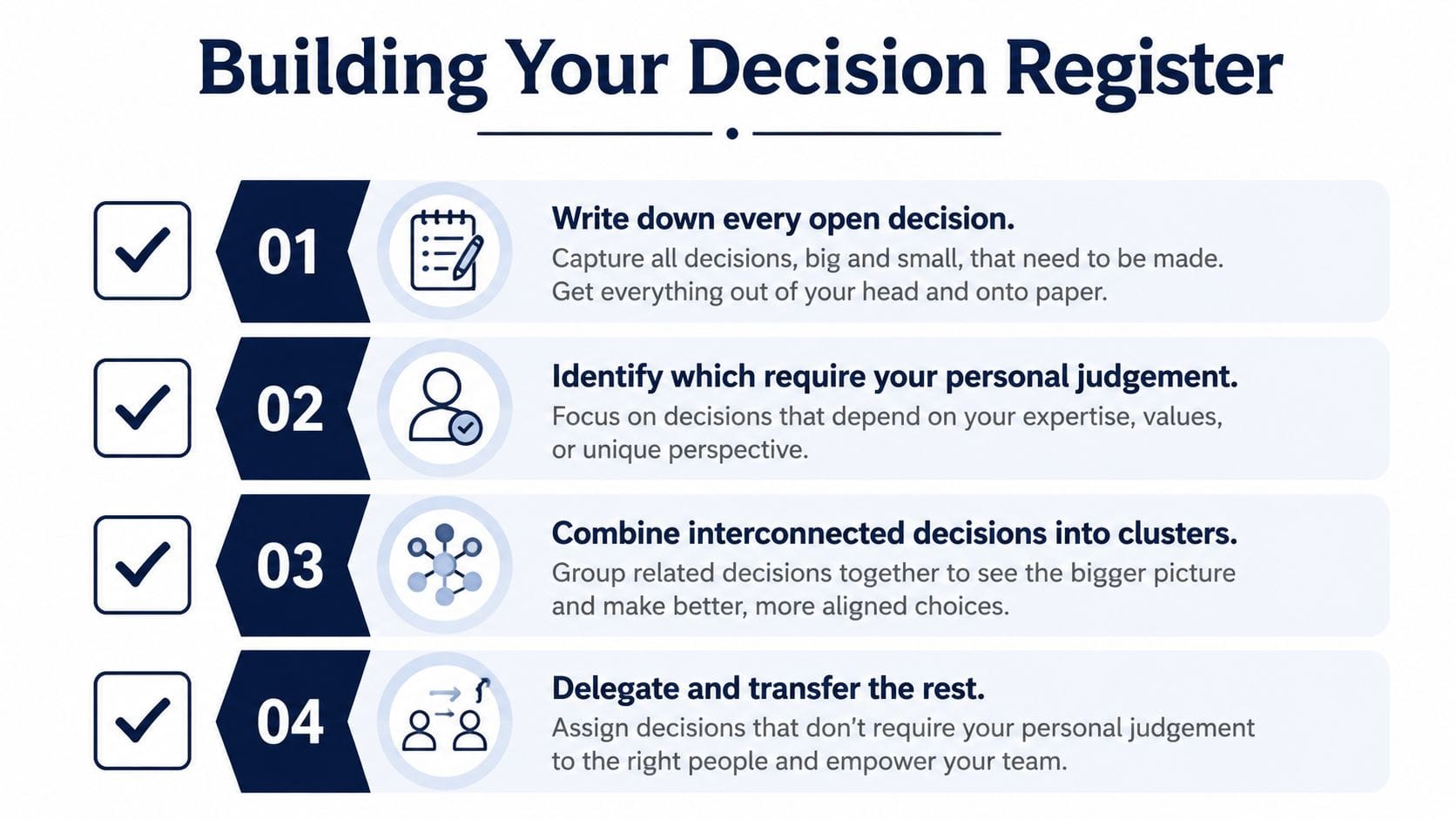
Record every open choice in one decision register showing what remains unresolved and who has the authority to close it.
Use six fields:
Decision | Move | Owner | Boundary | Deadline | Status |
Event purpose and recognition priorities | Retain | People and Culture lead | Agreed organisational objectives | Planning milestone | Open |
Venue, timing and transport | Combine | Event organiser | Approved budget and accessibility needs | Venue decision date | In progress |
Dietary information | Delegate | HR coordinator | Confirmed attendee requirements | Before final catering numbers | In progress |
Programme flow and equipment | Transfer | Event supplier | Approved brief and budget | Supplier confirmation date | Awaiting confirmation |
Minor styling variation | Eliminate | No owner required | Use venue standard | Immediate | Closed |
Then work through the event in this order:
- Record every open Christmas party decision.
- Identify the decisions that genuinely require your judgement.
- Combine choices that affect the same outcome.
- Delegate internal decisions with a named owner and clear boundaries.
- Transfer delivery decisions to suppliers who can own the result.
- Eliminate choices that do not materially improve the event.
If the same item keeps returning for discussion, it usually signals one of three problems: the decision belongs within a larger cluster, its boundaries are unclear or it sits with the wrong owner.
Connect budget decisions to the outcomes they support. This guide to creating a Christmas party budget that prioritises impact can help distinguish must-haves from extras that add cost without value.
What Better Christmas Party Planning Looks Like
When someone asks you to “just organise something simple”, they usually want an event that feels easy for everyone attending. Creating that feeling still requires careful decisions about purpose, people, inclusion, suppliers and the experience.
Better Christmas party planning does not mean putting less thought into the event. It means applying that thought at the right level.
The organiser retains the decisions requiring organisational judgement. Connected choices are considered together, internal owners receive authority, accountable suppliers manage delivery and low-impact details are allowed to remain undecided.
That is how an experienced organiser creates a thoughtful corporate Christmas party without personally carrying all 47 decisions.
Corporate Challenge Events can bring the programme, facilitation, equipment and event flow together under one experienced team, reducing supplier handovers and delivery decisions. Explore Christmas party ideas and team programmes designed to help teams finish the year with connection, recognition and plenty of play.




Recent Comments